|
BRITISH TELECOM: Sir William Ryland
Award (online version inspired by a visit to the workshops and yard of www.unicornkiosks.com)
|
|
||||
 |
|
||||
|
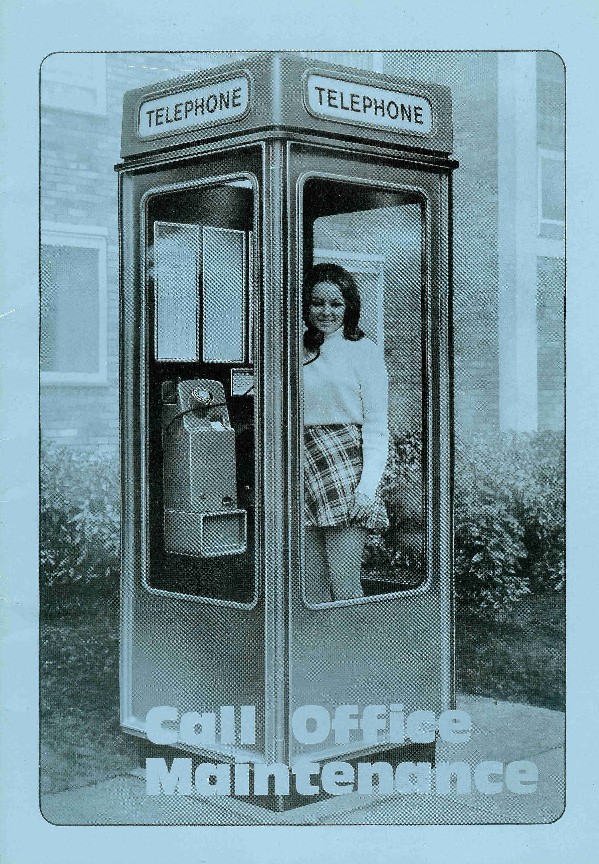
1975: Front cover
Post Office Telecommunications |
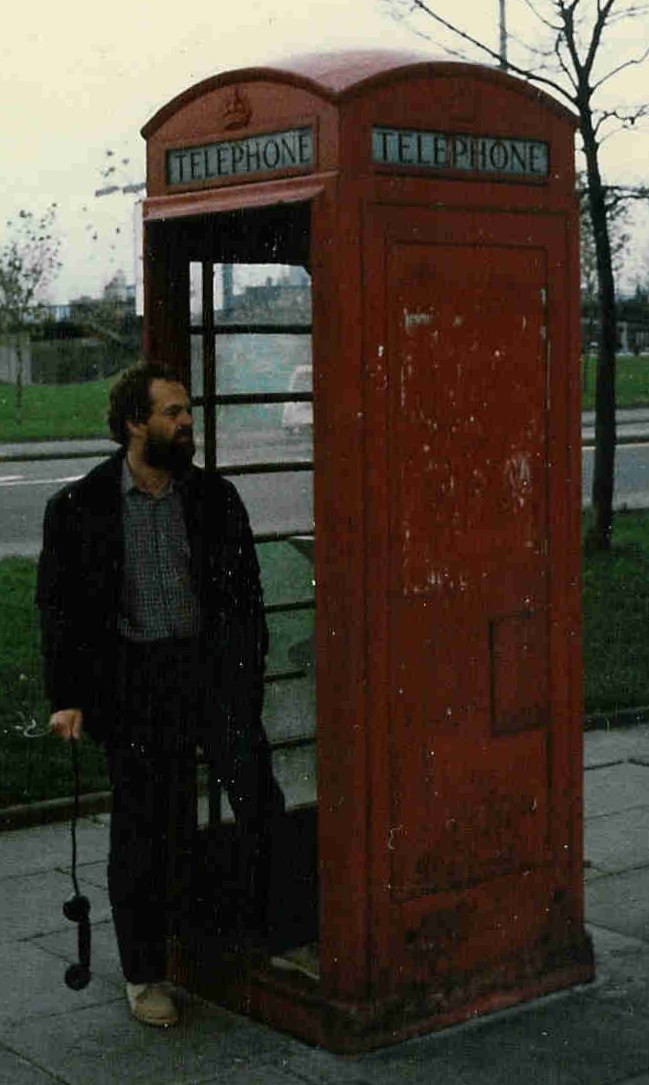
1982: With Handset 11A in hand, the author surveys a vandalised K6. Note the missing door, and the external steel plate providing reinforcement to the rear of the cash compartment |
||||
|
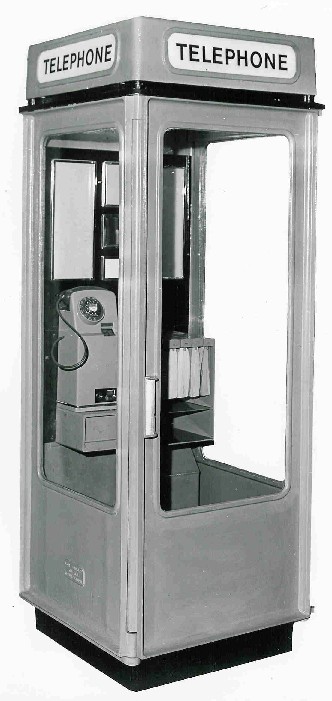
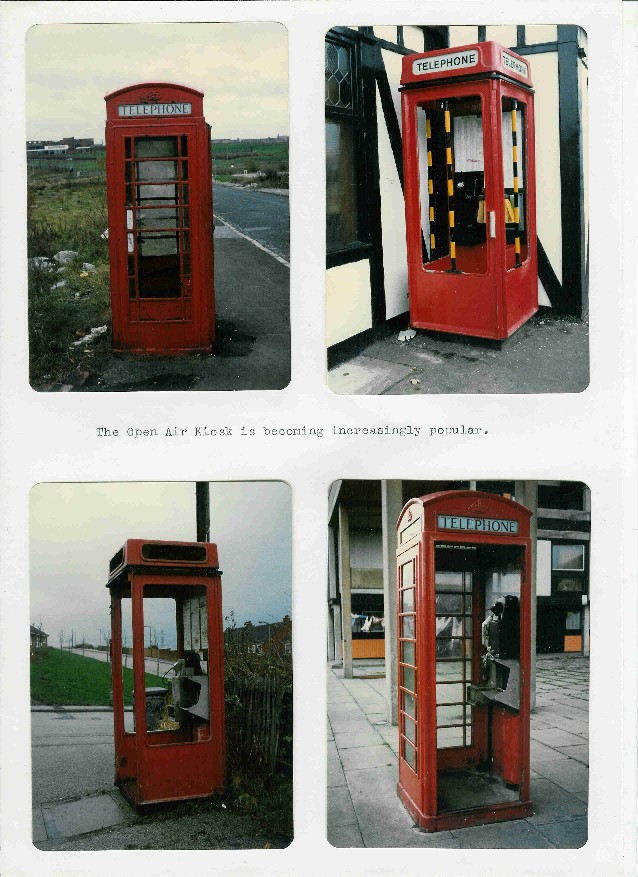
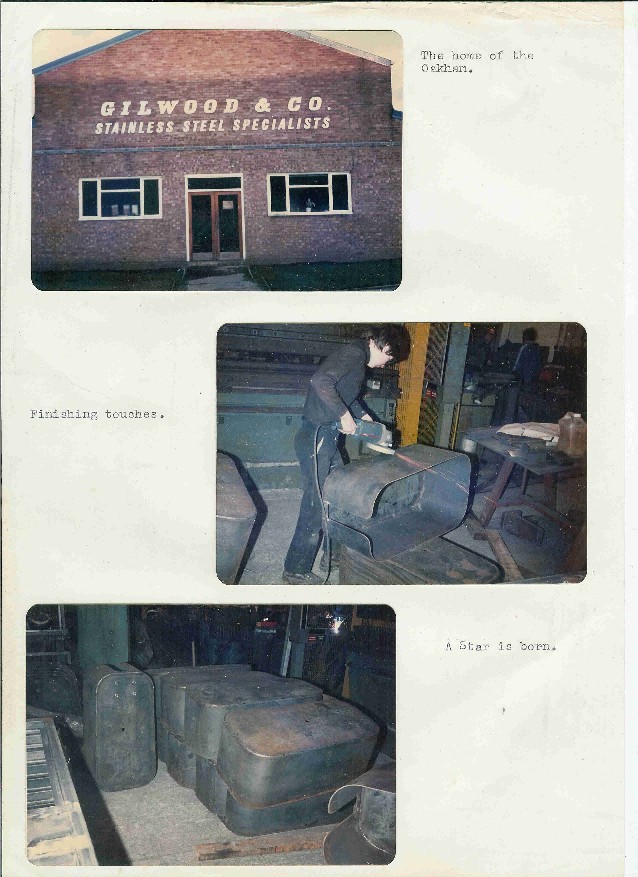
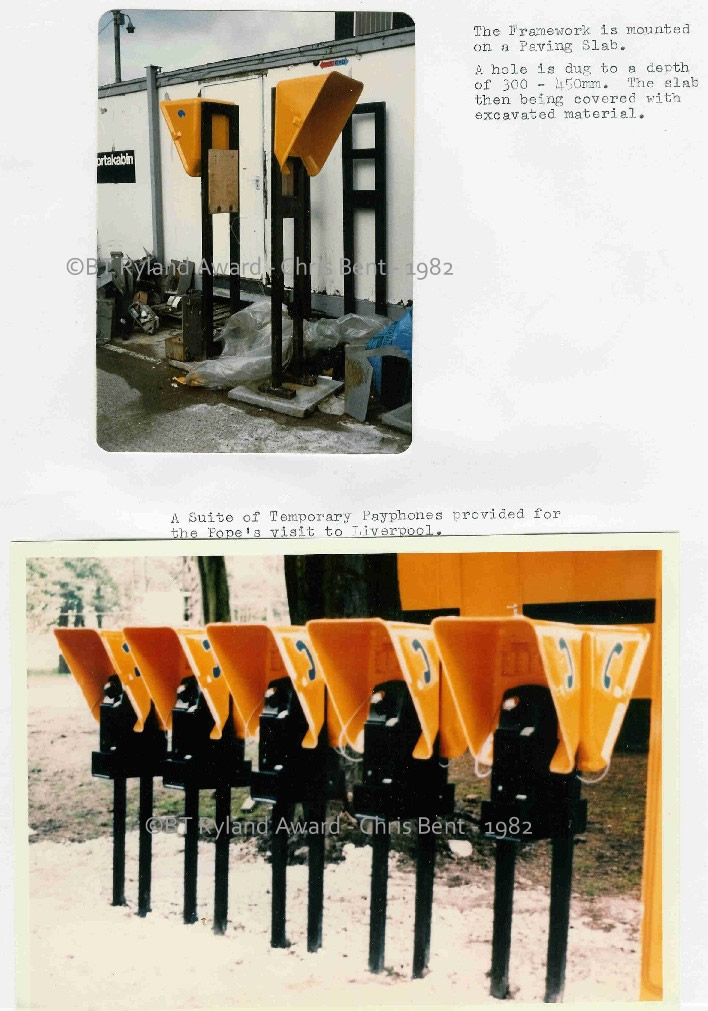
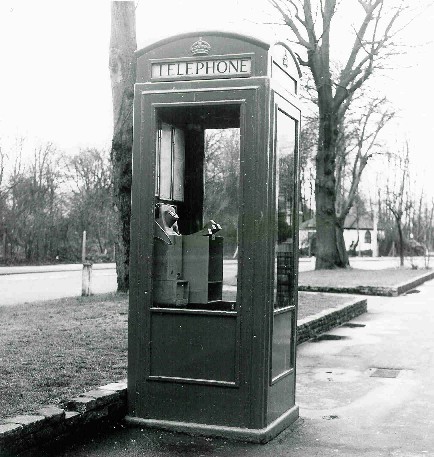
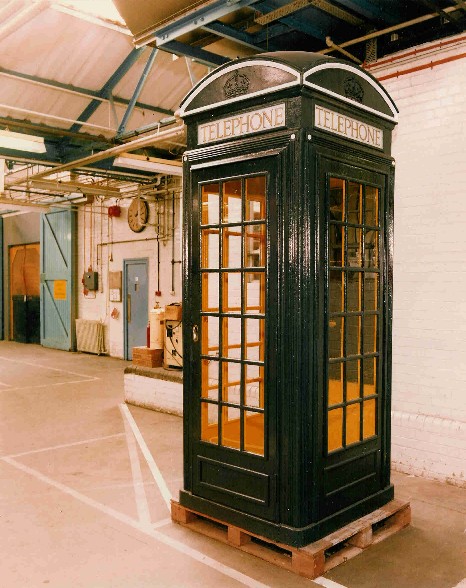
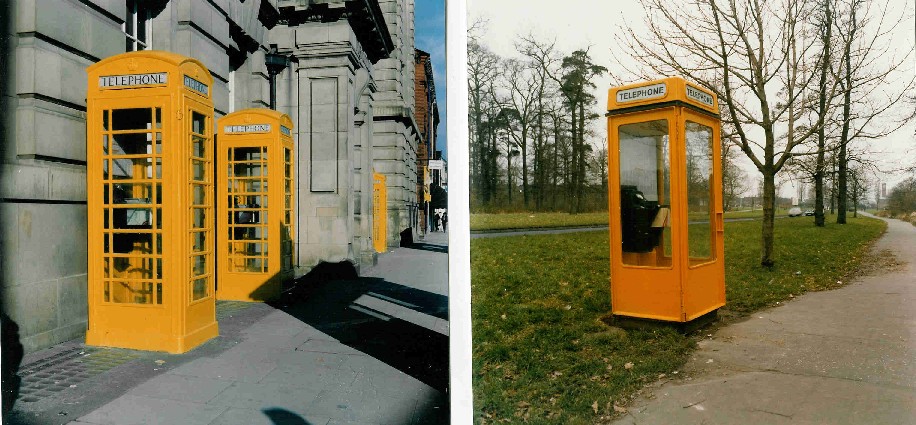
1982, for payphones, was a time of great change. Not that they were necessarily great times for the future of the resident street furniture, the family of K2, K6, K8. Already new colour schemes (Telephone Van Yellow) had been trialled, K2 and K6 kiosks had been officially butchered to resemble K8 kiosks with just three large windows. Ostensibly this was to deter the epidemic of vandalism by making the occupant more visible. There was a plethora of experimental kiosks, with or without doors, and an open air payphone on a stick - the ‘oakham’ (so called because the shape resembled an Oak ham canned meat tin).
The author joined the GPO, as the then Post Offices Telephones was commonly known, in 1971. Having served three years as a Trainee Technician Apprentice, government cutbacks in 1974 (sounds familiar) resulted in many apprentices moving out of the promised management stream and into normal technician duties. Chris was offered a choice of continuing to work in a lead lined Transmission Station or move sideways to Call Office Maintenance. Difficult decision; young of age, the freedom of a yellow van with multiple 30 minute payphone repair jobs at public telephone kiosks, clubs, hotels and hospitals - it was no contest.
Several years later (and by now being groomed for higher telecommunication duties in military airfield planning) the author gained a three month ‘holiday’ from normal duties (as Technical Officer) to investigate aspects of Payphone Provision. The journey included London, Birmingham, Liverpool, Edinburgh in the UK, with visits to European PTT and Payphone manufacturers in Geneva, Berne and Zug in Switzerland; Montluçon and Paris in France.
A programme to remove the familiar red telephone boxes was about to be instigated (for maintenance cost reasons) and they were to be replaced by characterless metal and glass boxes or the aforementioned open ‘Oakhams’ (mainly reserved for the most vandal prone areas). Mechanical Pay On Answer telephones were being replaced by electronic models and cardphones, the idea with phonecards being that with no money and no cash box, there would be no reason to attempt to break into the payphone, and ultimately result in less wanton vandalism.
Many Telephone Areas rushed headlong into removing and disposing of the K2, K6 and K8. Enlightened General Managers, or possibly those with no budget, managed to retain (to this day) many of the old familiar kiosks. It’s true, have you ever wondered why some villages have the trusty rustic red kiosk, whilst the next village has a brushed steel monstrosity? Answer, usually you have driven from one (old) Telephone Area into a different telephone Area. The extent of a Telephone Area can generally be determined by looking at an old 80’s telephone directory.
revised September, 2019, Chris Bent. To be continued…
|
|||||
|
click on any thumbnail to see larger image |
|||||
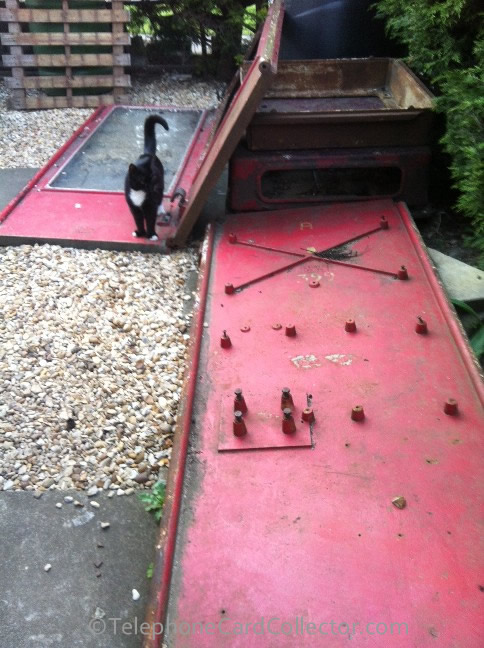
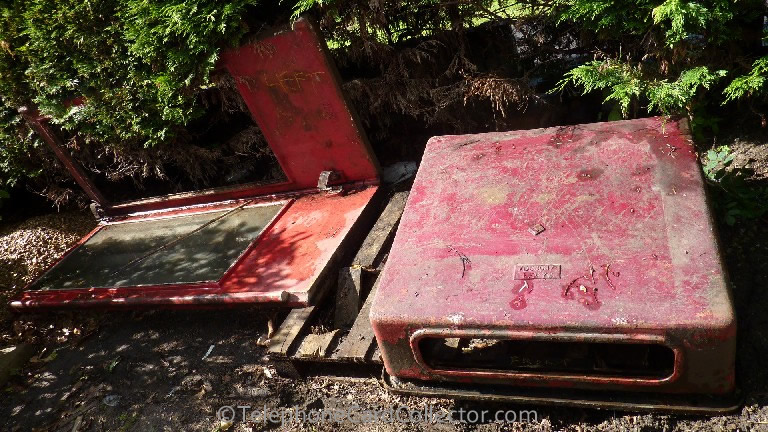
| The author's K8 has been across the Atlantic Ocean and back. Now in sections, bolts have sheared off in the kiosk sides rendering it impossible to secure safely to the crown and the base. Also, two corners of the base are broken. |
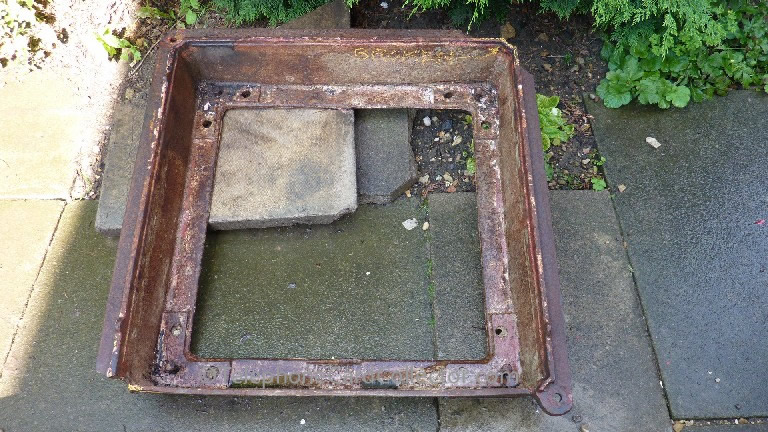 |
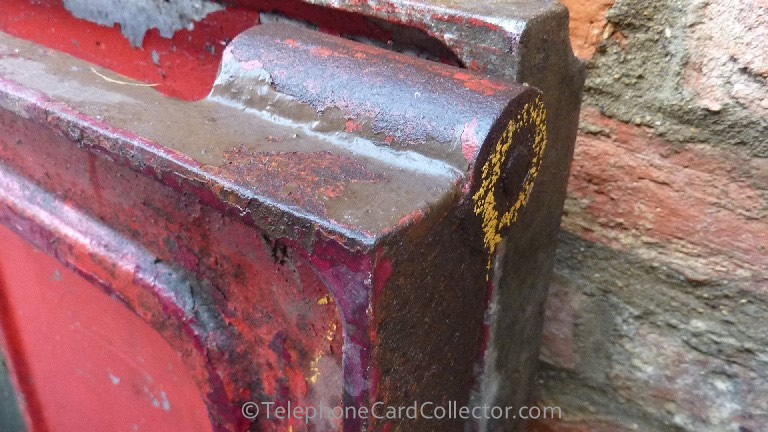 |
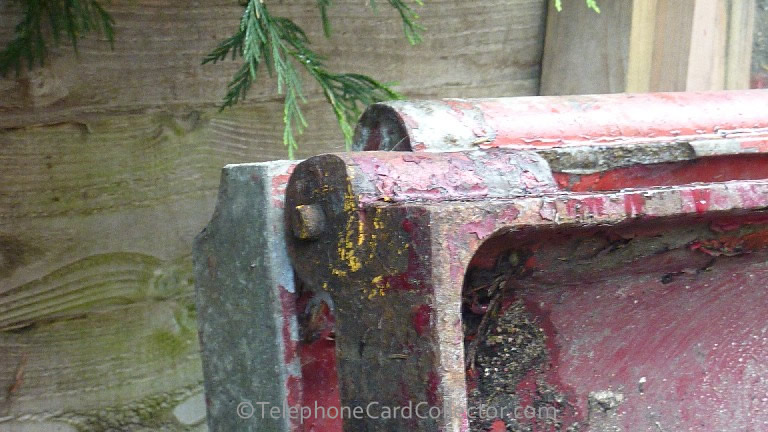 |
||
|
|
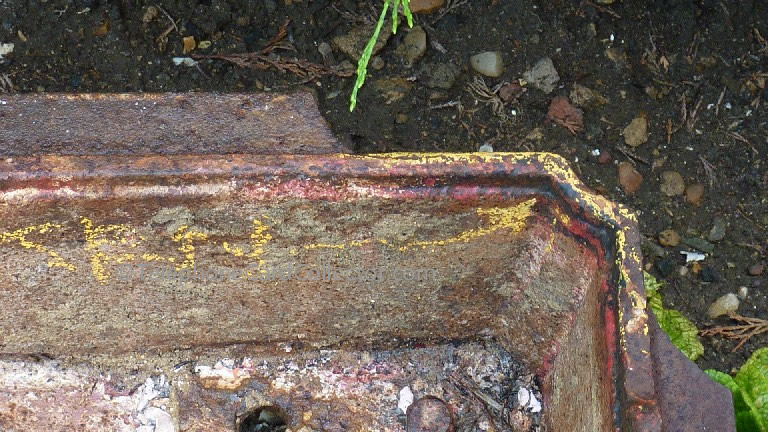
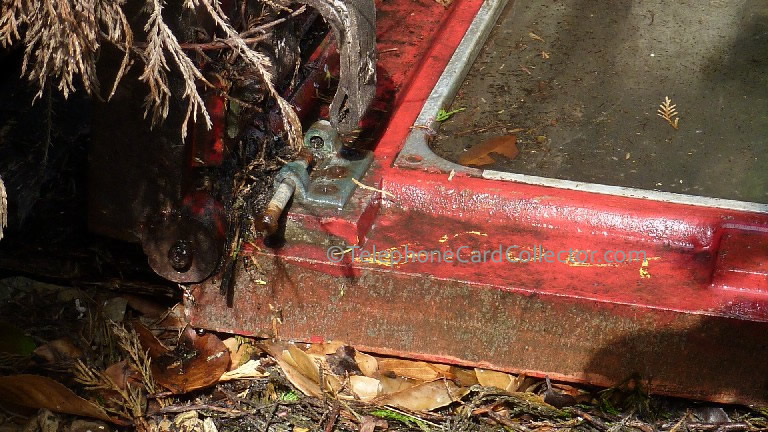
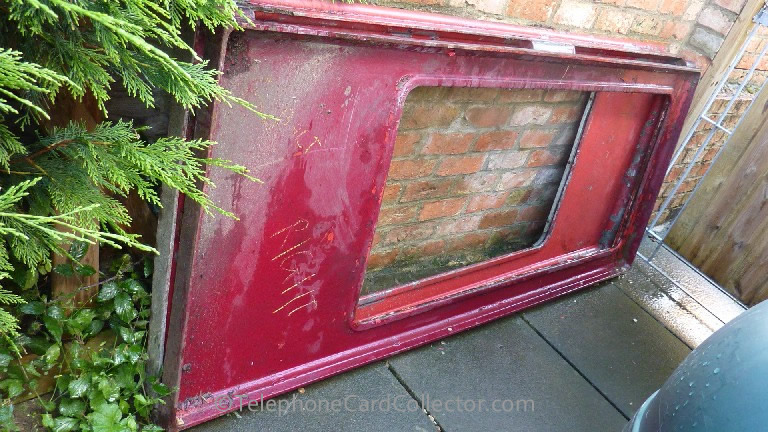
This kiosk was originally recovered from its street location because the bottom front right hinge corner had fractured. Each time the door was opened the lower left side of the kiosk side panel also began to move alarmingly away from the base. |
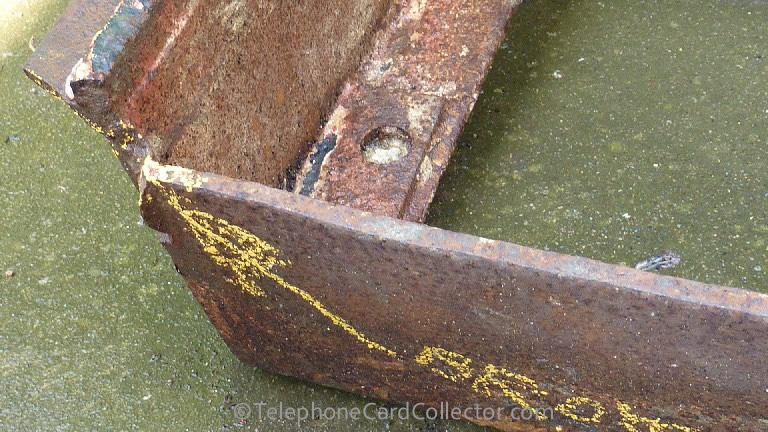 |
 |
 |
|
 |
 |
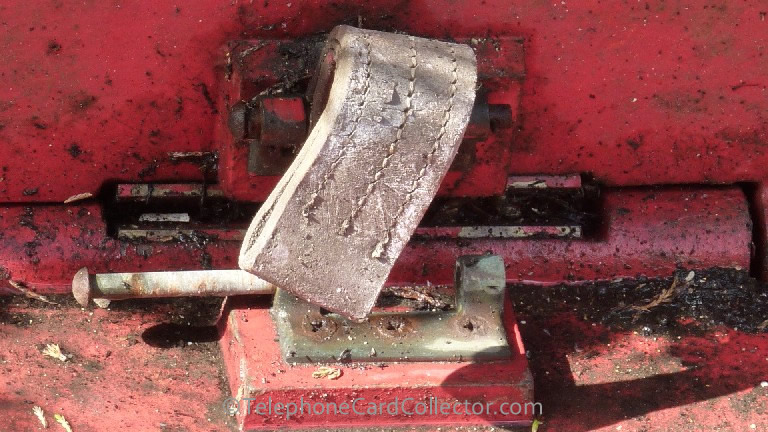 |
|||
| Unicorn Kiosks Summer 2014 - Telecommunications Heritage Group (THG) open day. Photographs copyright Chris Bent |
 |
 |
 |
||
| Knitting pattern for official British Telecom Buzby Jumper... with sparkly new K8 on location |
 |
 |
 |
||
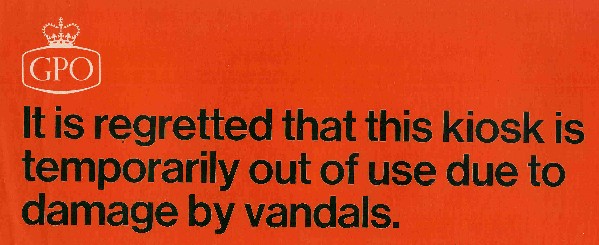
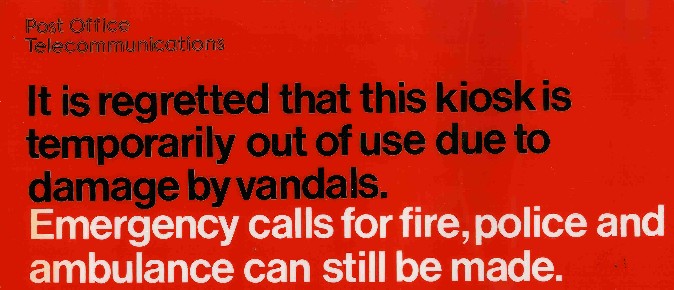
| Kiosk warning notices |
 |
 |
 |
||
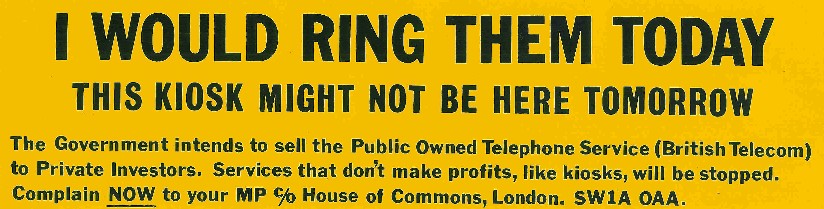
| Political Kiosk notices - No to Privatisation |
 |
 |
 |
||
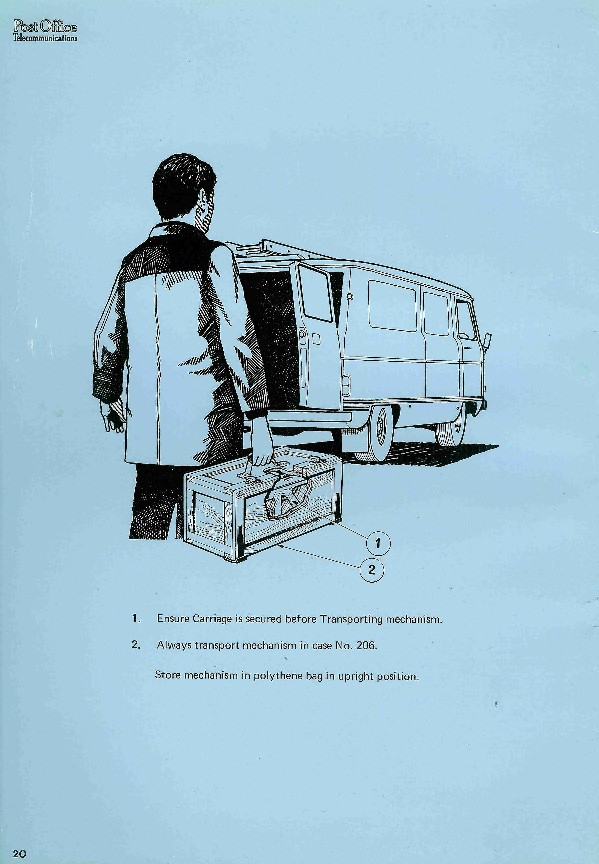
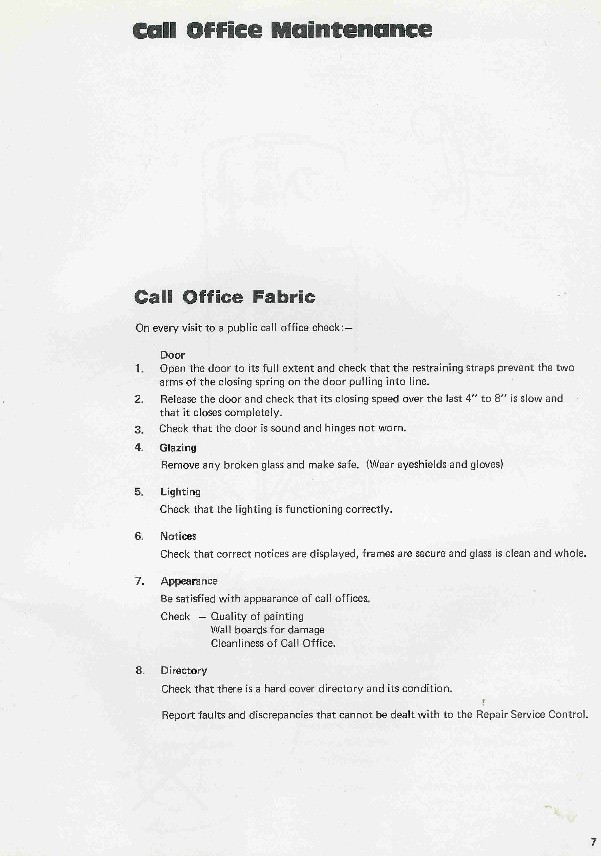
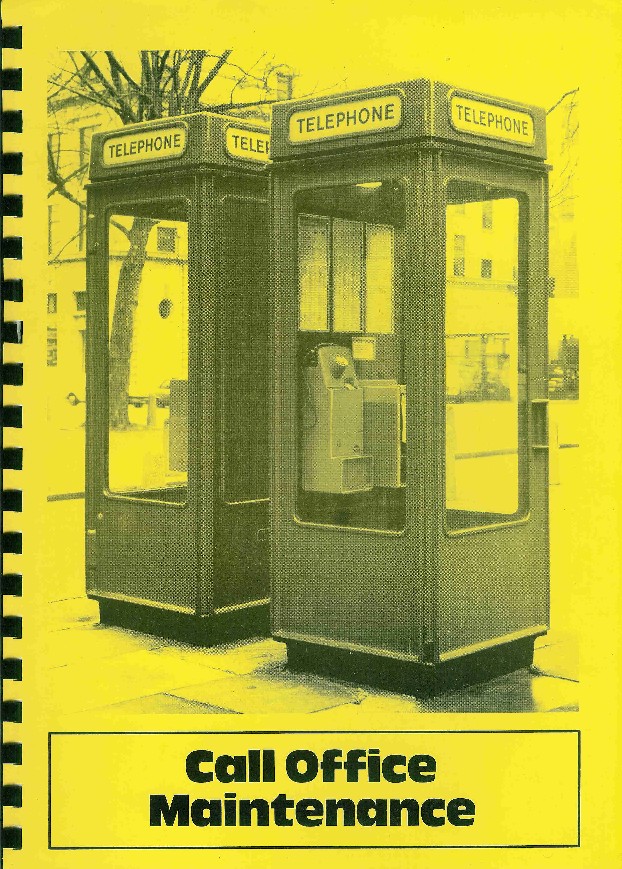
| Rear cover of Technicians Call Office Maintenance manual + two sample pages |
 |
 |
 |
||
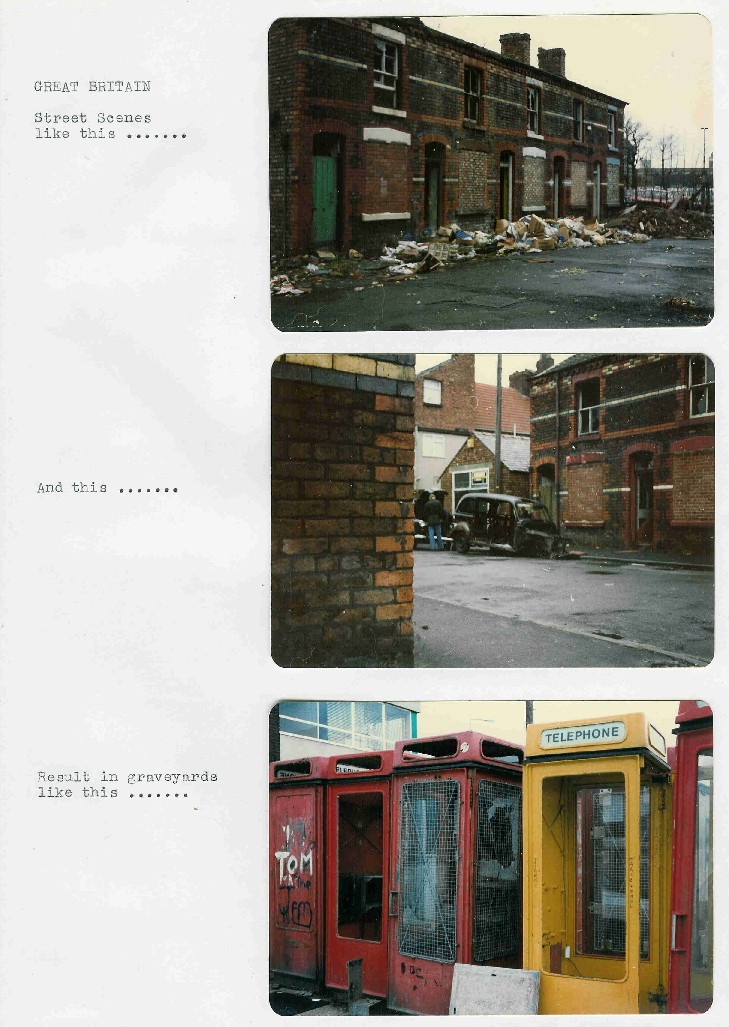
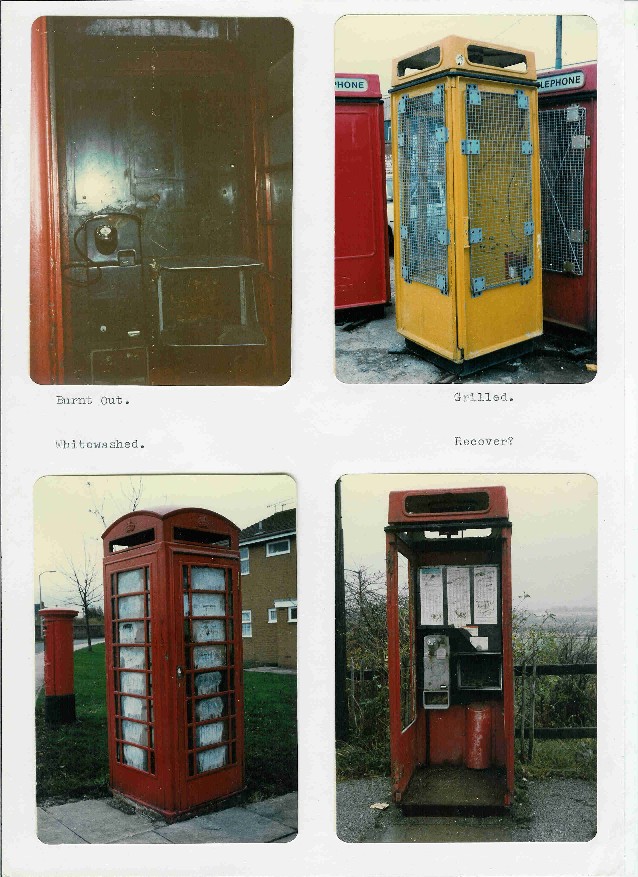
| Pages taken from the
author's original 1982 report Far right: note the K8 with the black and yellow vertical bars; an official K8 part designed to prevent callers leaning against the non existent glass and falling out of the kiosk. No surprises to learn that it was a 'Bar, Safety, 1A'. Photographs copyright Chris Bent |
 |
 |
 |
||
| Open
Air Payphones: The 'Oakham' open air housing manufactured at Gilwood Fabrications, Skelmersdale. For locations where kiosks were constantly being vandalised. Photographs copyright Chris Bent Far right, temporary outdoor payphones for the Pope's visit to Liverpool |
 |
 |
 |
||
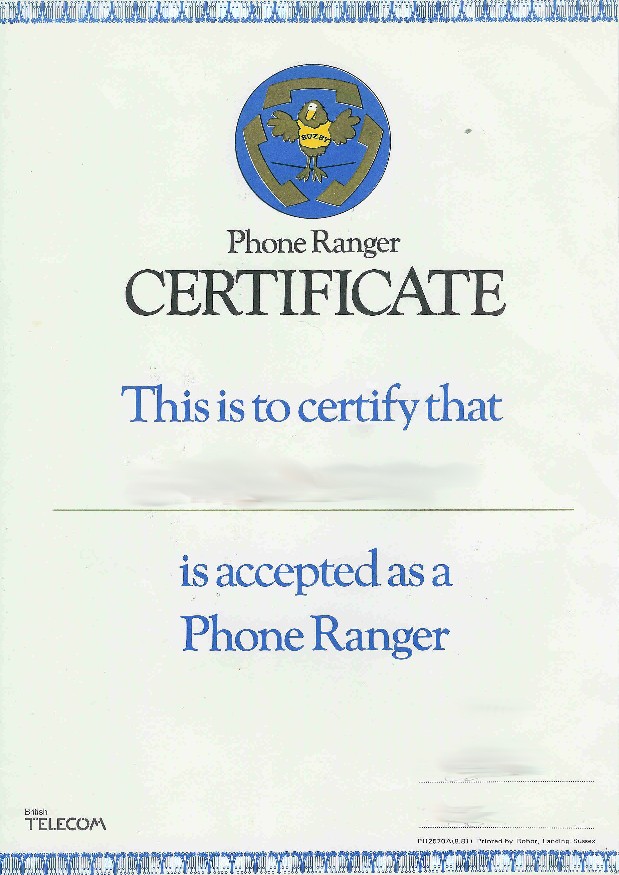
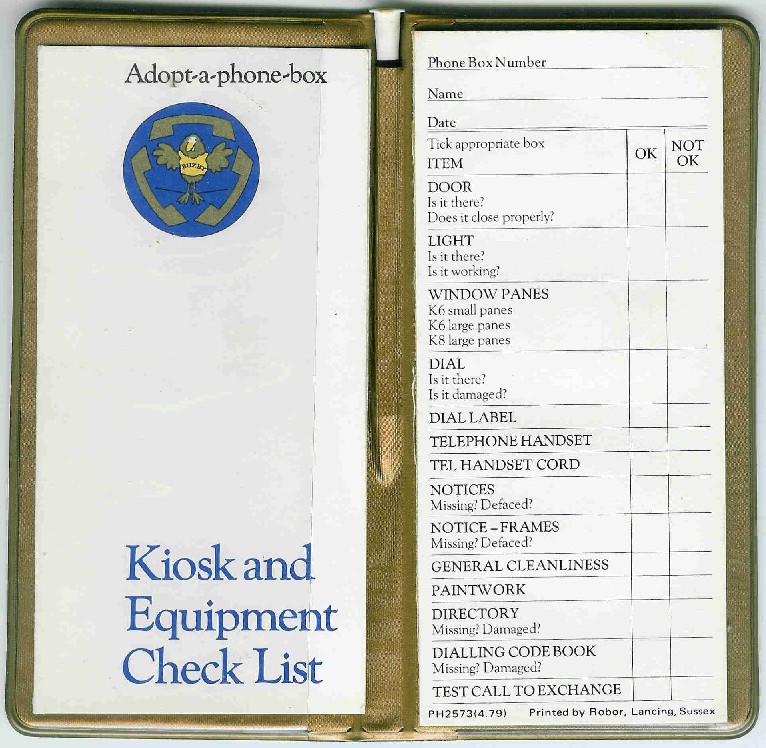
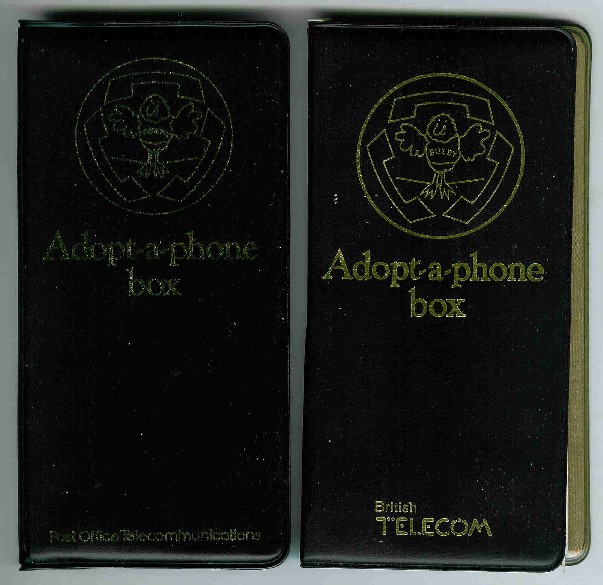
| The Phone Ranger:
Children were encouraged to take
responsibility for local kiosks |
 |
 |
 |
||
|
Modified K6 Experimental colour schemes |
 |
 |
 |
||
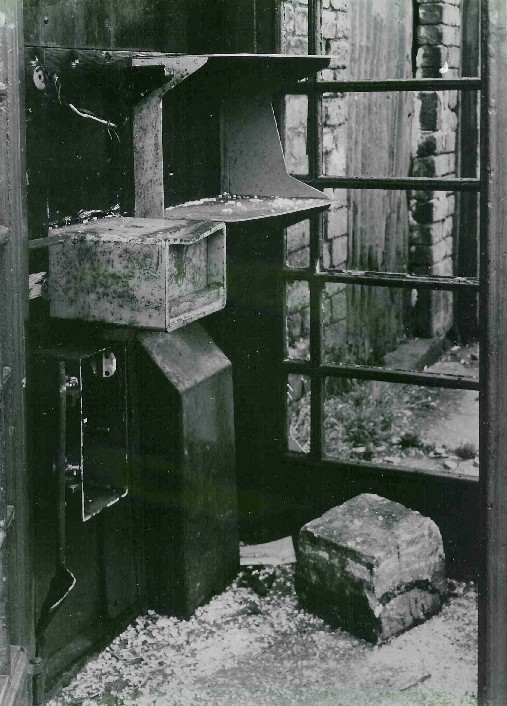
| Smashed, blocked...
Note the K6 (and the cube of concrete)
with nothing remaining except the fortress cash compartment |
 |
 |
 |
||
|
|
|||||
|
a selection of typical items jamming the mechanism of a public pay on answer telephone (the locks were attached to the handset cable) |
|||||
|
CASH COLLECTION LOGISTICS In a throwback to the time when the GPO were responsible for both telecommunications and postal services there remained a demarcation between who accounted for actual coins (the Head Post Office or Main Sorting Office) and the Engineering department who were responsible for technical and fabric maintenance. The author was the only technician in the Peterborough area who regularly visited the main Post Office accounts department for the purpose of collecting a key to gain access to a jammed cash compartment. At this stage please note that the cash COMPARTMENT is a permanent part of the payphone in the kiosk. A cash CONTAINER is the metal box which fits into the cash compartment and is capable of being removed and replaced as often as desired. Importantly, it was the POSTAL division who drove a van, calling at various kiosks on a predetermined route. The postman would have a large bunch of keys with each key matching a specific kiosk and, at the start of the route, a van full of empty self sealing cash containers - primed for use by the accounts department. |
 |
||||
|
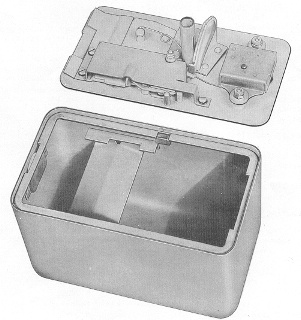
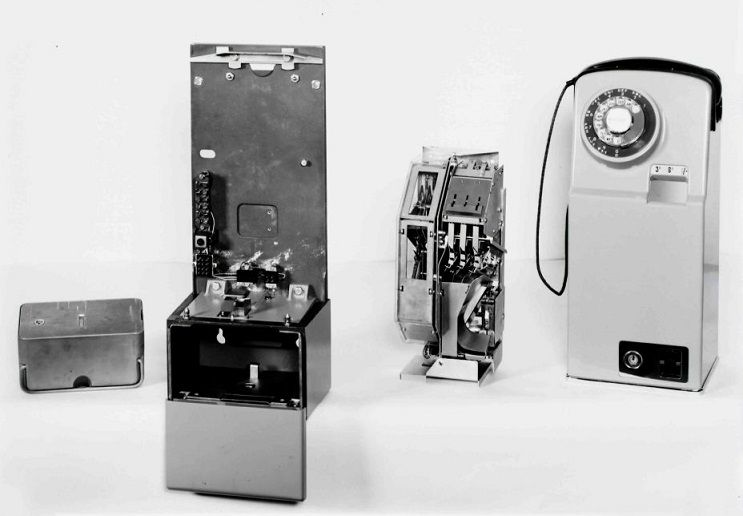
Early version of Pay On Answer public
telephone no.705 From left: cash container, cash compartment, mechanism, outer casing |
|||||
| The cash container would be slid into the cash compartment of the payphone, where a permanently mounted 'key' would fit into a slot in the top rear of the cash container, thus activating the self sealing mechanism for when the container was removed a few days later. The cash container could sometimes move forwards enough to misalign the money chute with the open slot in the cash container - thus causing money to jam throughout the mechanism above the cash compartment. In these situations (perhaps vibration caused by heavy traffic) I would fit a pair of magnets (an official spare part) inside the rear of the cash compartment - the theory being that the powerful magnets would hold the cash container at the rear of the cash compartment, thus preventing forward movement, |
|
|
|||
|
An open cash
container |
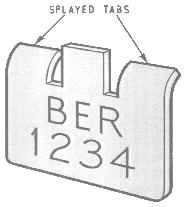
Label no. 292 to identify kiosk was inserted into a slot at the end of the cash container | ||||
|
Occasionally a cash compartment lock (LOCK no. 6) would prove stubborn (generally due to inadequate lubrication or rusting caused by exposure to 'liquids') or, with the keyhole being awkwardly on the underside of the cash compartment, sometimes the postal officer would lose balance and bend or break the key shaft. Not that anyone will be disciplined for clumsiness some 40 or more years later. So, it fell to the author to regularly visit the Post Office accounts team and sign for the key which was unique to that particular telephone kiosk location. Generous use of oil or silicone sprays would usually persuade the most stubborn lock to accept the key and allow it to turn. If this failed, a special drill bit was required to drill a hole directly through the lock and the heavy duty front plate. A 'new' lock was required to replace the irreparable one. Note that in the mid 1970's these locks were like gold dust and it became essential that the payphone technician was motivated and capable of dismantling and refurbishing as many locks as possible.
|
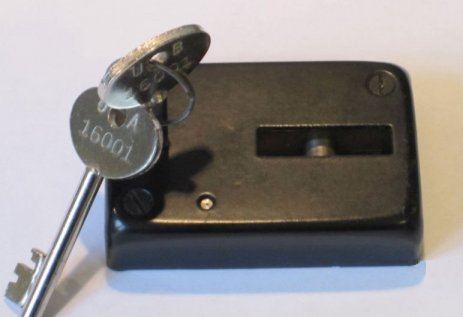 |
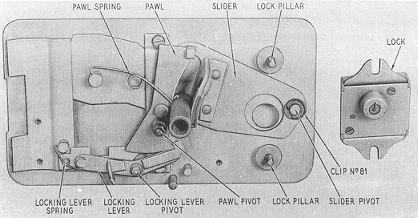
Lock no. 6 was used inside the cash compartment - the front plate of the cash compartment fitted into this lock. This lock was positioned such that the postman needed to insert a key from underneath into a hole in the cash compartment. | |||
| Having gained access to the cash compartment the cash container would be returned to the Post Office accounts team along with the key which was unique to that kiosk's cash compartment lock. The cash containers all opened with the same key at the Post Office and the container would be opened as I stood there whereupon the contents would be poured into an automatic coin counting machine. One other point to mention is that the engineer could be instrumental in altering the frequency that particular kiosks cash containers were emptied. If it was obvious that a mechanism was regularly becoming jammed with coins simply because the cash container was full I would discuss this with the officer in charge of the collection 'round' and request that he/she consider emptying a certain kiosk more often. Thus it was ensured that the public experienced as few blocked payphones as possible. |
|
The internal mechanism of a cash container 'lid' | |||
|
|
|
||||
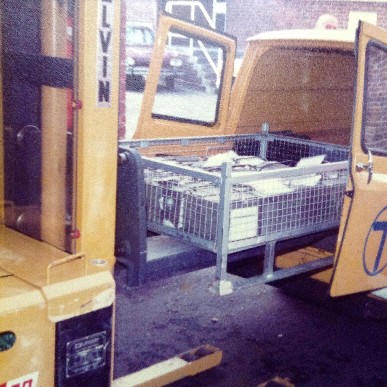
| A poor quality photo (taken by the author) of a cage of full cash containers being returned to the Post Office accounts team |
Cash Containers being loaded into a British Telecom van. |
||||
|
Did you work for the Post Office (postal or telephone)? Did you collect the cash containers from the telephone kiosks? Did you open the cash containers at the accounts office? Does the above description, based upon my duties in Peterborough, accurately describe what happened in your region/area prior to privatisation? CASH RECONCILIATION... But what of the cash which was jammed in the mechanism - some of which had not been registered as being collected? Equally, what about the cash which had registered as being collected but had not in fact got as far as the cash container? With a jammed mechanism it was sometimes possible to make free calls. Photographs were taken of the meter readings in the telephone exchange. The coin and fee checking equipment in the exchange had registered that calls had been made. With 'over full' containers and coins jammed in the mechanism there was bound to be a discrepancy. Did the Post Office Accounts team attempt to reconcile meter readings with actual cash collected/counted. Was there an accepted tolerance of 'missing' (or excess) cash? Who would be under suspicion? Would the Post Investigation Division be called upon? Please contact me in
confidence via: |
|
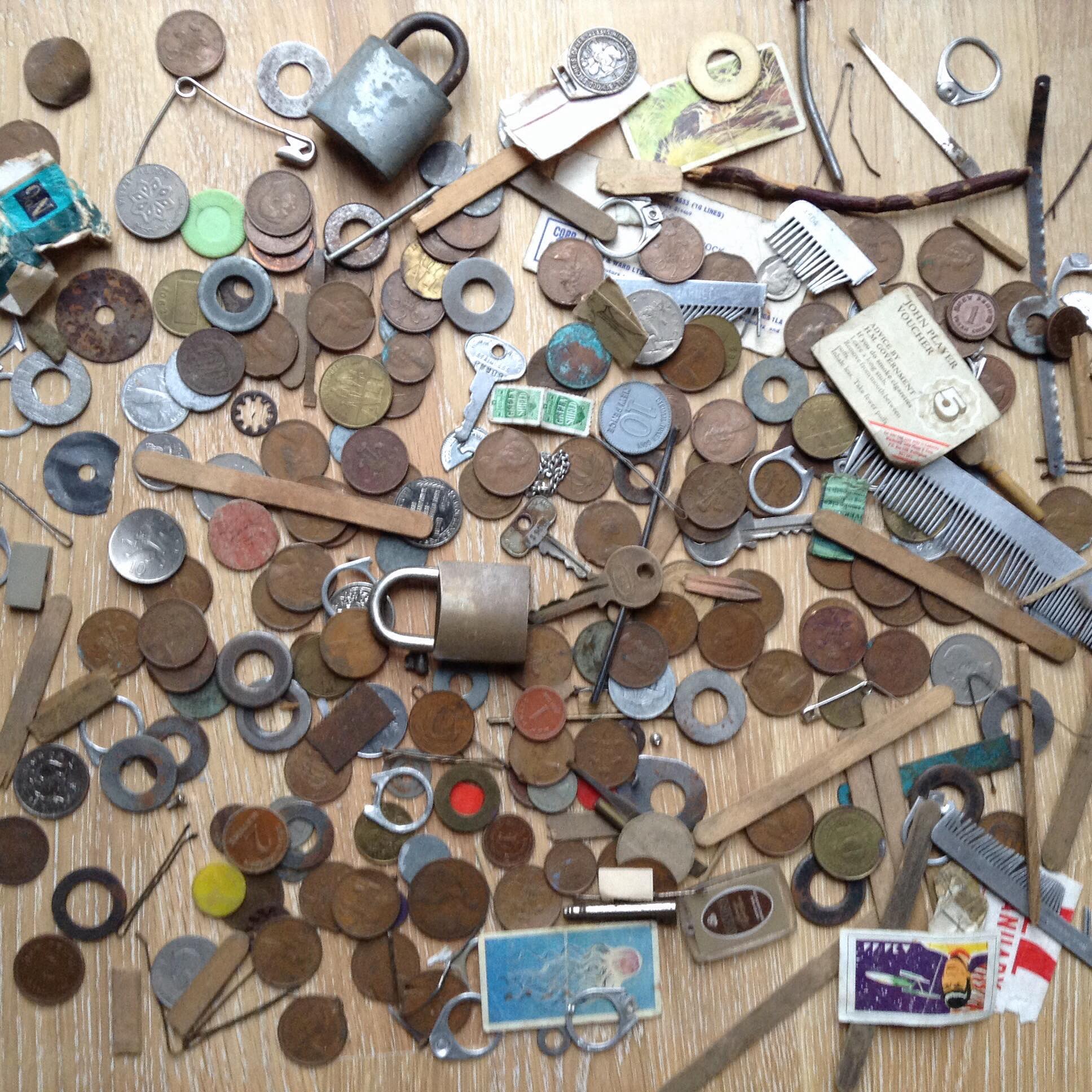
<< a typical selection of damaged coins, foreign coins, washers, steel combs, hacksaw blades, lollipop sticks, hairgrips, tokens, keys, nails, twigs, card... all recovered from the internal mechanism of public telephone kiosks, circa 1975. Invariably these items would have ultimately resulted in blocked coin slots and a fault report of CSJ = Coin Slots Jammed. The locked padlocks would have been found attached to the handset cable (click on thumbnail to enlarge) | |||
|
The words of the
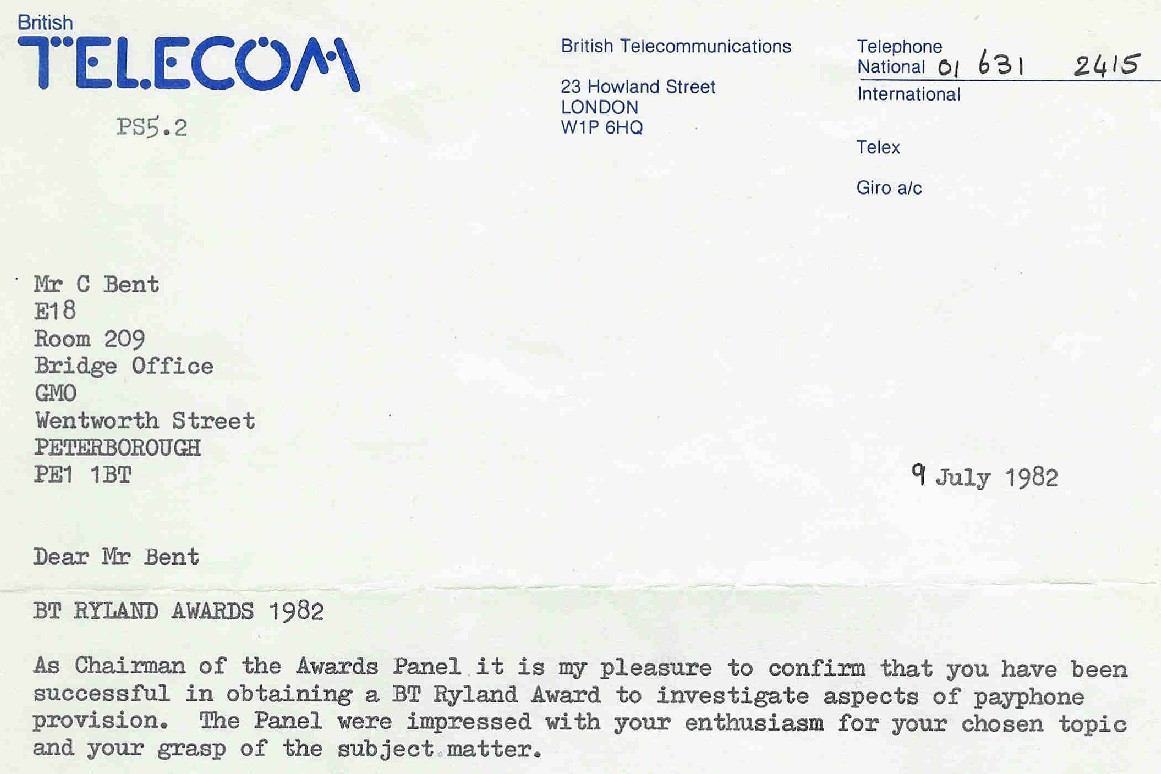
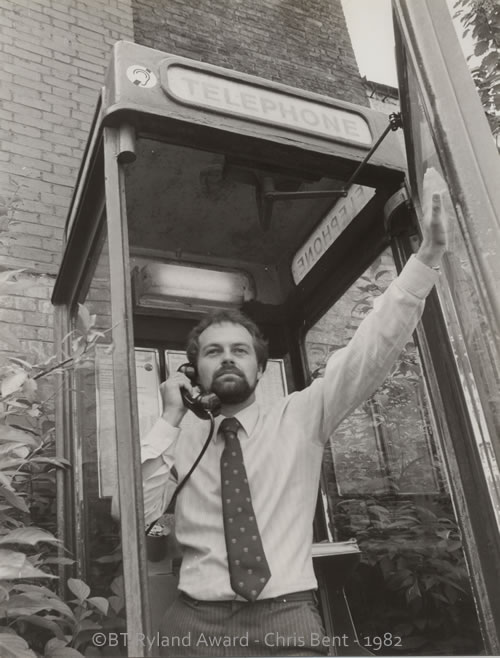
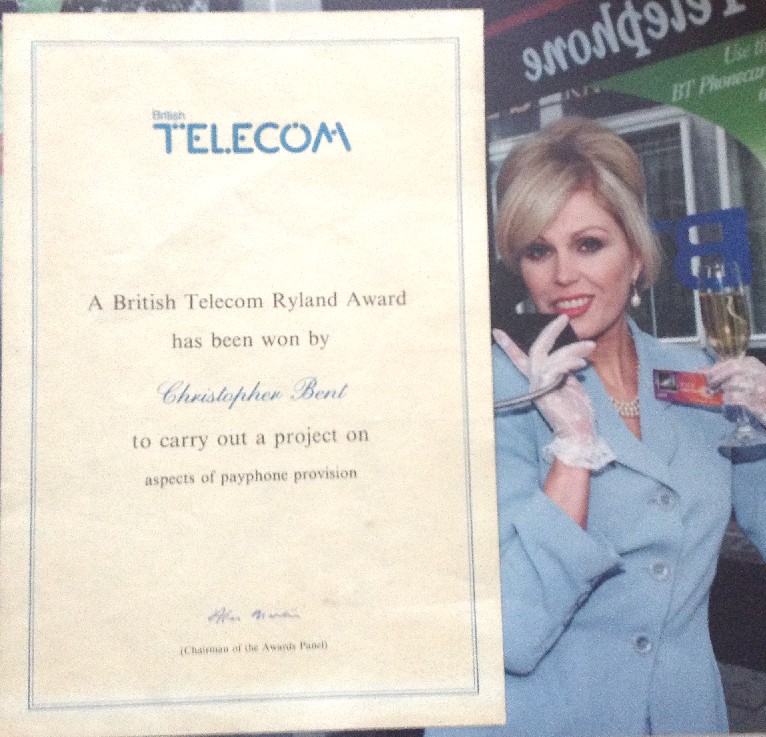
British Telecom Ryland Award read: '... Christopher Bent to carry out a project on aspects of payphone provision' The award included £2000+ to be spent on travel and hotels, with a mentor based in Birmingham to call upon to arrange and coordinate meetings in the UK, Switzerland and France. The certificate is framed within an official BT portrait of Joanna Lumley, who was chosen to be the poster girl for the launch of the second generation BT phone cards As an elected POEU (Post Office Engineering Union) and HASAW (Health And Safety At Work) representative I may have been regarded by local management as the least likely person to be expected to win such a valuable and responsible award... Fortunately the awards committee - around half a dozen people at London BTHQ fired questions at me - appreciated my confidence and enthusiasm for the Cinderella of telecoms: the humble and mistreated payphone... Bearing in mind that it had been six years since I had actually worked on payphones, I was invited to Telecom Headquarters in London to be appraised of the latest developments. The Head of Payphones in London invited me, after completion of the project, to consider a transfer with promotion to his department. Unfortunately having just purchased a plot, and with a recent second child being born, I was keen to commence building a new home for my family. I put my family first and reluctantly declined. With hindsight an unwise decision maybe. When I had completed the project I returned to my normal external planning duties in Peterborough Telephone Area. It was as though the previous months had never happened. Nothing was said until I resigned some seven years later - to join with my wife opening a childrens day nursery at the house we had built together. The General Manager summoned me to his office and belatedly explained that he had tried to use my knowledge of payphones and promote me to a specialist Payphones post... but the appointment and/or post had apparently been blocked by the unions... Thus ended my telecoms career of 18 years and I thank him for being so candid and truthful. |
 |
||||
|
To follow: Hundreds of unpublished kiosk and payphone/cardphone pix Examples of experimental kiosks Trial reports for the blue payphone and tier two phones Trial reports for the optical cardphone Video report - unpublished France PTT literature and payphone notices Literature and reports from the cardphone manufacturer Landis & Gyr and Sodeco Rare phonecards - Swiss Parliament, blank optical cards etc Engineering/Telecommunication Instructions |
|
||||
 |
 |
||||
|
Earlier editions of
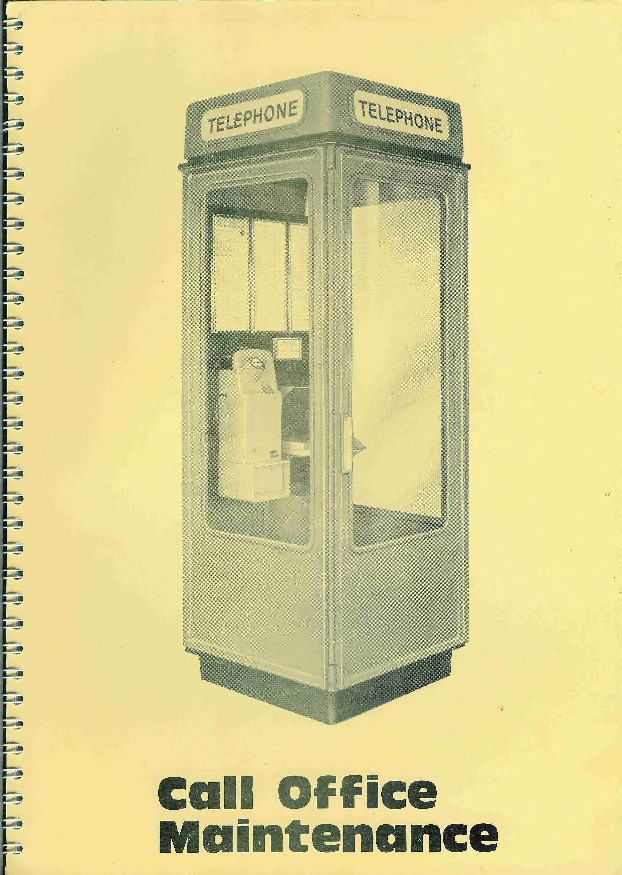
the Call Office Maintenance Manual - more pages to follow. |
|||||
|
Biggest regret? Handing in a mint condition pay on
answer mechanism which catered for 3d, 6d, 1/-
Interesting fact: The K6 had a wooden framed door -
usually. In three years of call office maintenance duties visiting
hundred of kiosks I only ever came across one solitary K6 with... a
fully metal cast (iron?) door. contact this website via the
home page |
|||||